Emergency Plumber in Hamilton, OH
Hamilton Pro Plumbing answers the phone 24/7 for burst pipes, sewage coming up a floor drain, a dead water heater or a sump pit that keeps rising. An emergency plumber is the call you make when water is going somewhere it shouldn't and waiting until morning will cost more than the fix itself.
Call (513) 796-9381 and a person takes the details at any hour, Sundays and holidays too.
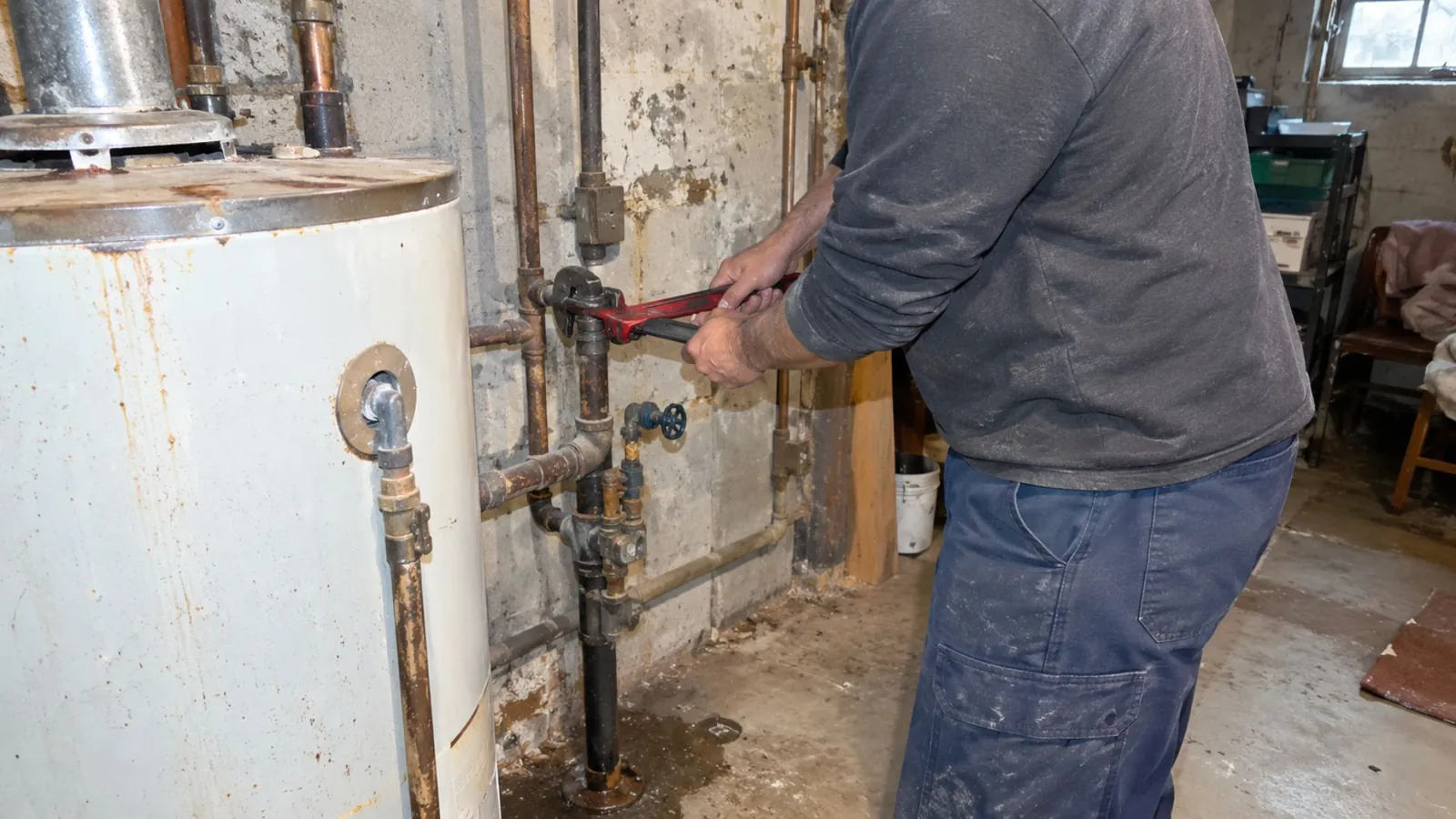
What a 24/7 emergency plumber handles in Hamilton
Most after-hours calls from Hamilton homes fit one of four patterns. Water is escaping from a supply pipe. Sewage is coming back up a basement floor drain. A family has no hot water on a January night. Or a sump pump quit while rain is still falling on the Great Miami River valley.
Every one of those gets more expensive by the hour, which is why the line stays open 24/7. A pinhole leak in a copper line can release several hundred gallons overnight if nobody closes the main. Sewage that sits on a basement slab soaks into drywall, carpet and stored boxes within a few hours.
When you call, the questions are simple. What do you see, where is it, and have you shut the water off? Those three answers tell the plumber which tools and fittings to bring. A burst galvanized line in a Rossville basement needs different parts than a split PEX run in a 2005 Liberty Township house.
A backed-up main needs a cable machine and a camera, not a wrench. If that is your problem, our page on drain cleaning in Hamilton covers how a clogged lateral gets cleared and checked. When the pit is filling faster than the pump can empty it, the sump pump repair and replacement page explains the usual causes.
We won't promise an exact arrival minute, because traffic on the High-Main Bridge or a closed road can change that. You get a realistic window on the phone. You also get the price for the work before anyone starts it, so nothing on the bill is a surprise.
Plumbing services for Hamilton homes and businesses
Pick the closest match to what is going on. Each page explains causes, repair options and what drives the price in Hamilton specifically.
How old is your Hamilton home, and what is inside its walls?
Hamilton's housing runs from 1860s Italianate homes to subdivisions built after 2000. The age of the house is the best single predictor of which pipe fails first, so it is the first thing we ask about.
| Era | Where you see it | Typical supply pipe | Typical drain | Check this first |
|---|---|---|---|---|
| Built before about 1920 | German Village, Dayton Lane, Rossville | Galvanized steel, sometimes a lead service line | Cast iron stack, clay tile lateral | Line material, rusty water, a cracked stack. |
| Built in the 1920s to 1940s | Older blocks outside the historic districts | Galvanized steel | Cast iron, clay tile lateral | Low pressure at upstairs fixtures, roots in the lateral. |
| Built in the 1950s to 1970s | Postwar ranches and split-levels | Copper | Cast iron or early plastic, clay or fiber pipe to the street | A camera look at the lateral before any big remodel. |
| Built in the 1980s to 1990s | Newer edges of the city and nearby townships | Copper or CPVC | PVC or ABS | Water heater age, pinhole leaks in copper. |
| Built in 2000 or later | Subdivisions in Liberty and Fairfield Townships | PEX | PVC | Crimp fittings, sump pump and discharge line. |
These are typical patterns, not a guarantee. Plenty of older Hamilton homes have been partly repiped, and the only way to know is to look at the pipe where it comes through the basement wall. The practical point is this: if you own a pre-1920 house in one of the three historic districts, budget for the drain and supply lines as a system, because patching one galvanized section often just moves the leak to the next joint.
Lead service lines: what the city is replacing and what you own
The City of Hamilton has run its own water utility since 1884. Its water comes from 21 deep wells drilled into the Great Miami Valley Buried Aquifer, serving roughly 25,000 customers in the city and parts of Butler County. The water leaving the plant is treated and tested. The concern is the pipe between the street and your faucet.
Older Hamilton homes can still be fed by a lead service line. The city has published a service-line inventory map that estimates each address's pipe material, using records plus a prediction model where records are missing. The utility's side usually ends at the curb-stop valve, and everything on the house side of it belongs to the owner.
Hamilton has announced funding to replace lead lines in the public right-of-way, the stretch from the main to the curb stop. The private stretch from the curb stop into your basement is still the homeowner's to replace. If the map shows your address as lead or unknown, the useful next step is confirming the material at the meter, then pricing the private side while the city work is scheduled on your street.
Our page on water line repair and replacement covers how that private section is replaced, trenched or pulled, and how long the water is off.
Check your own service line in two minutes
- Find where the water pipe enters the house, usually through the front basement wall before the meter.
- Gently scratch the pipe with a coin or key. Lead scratches to a shiny silver color and is soft.
- Hold a fridge magnet to it. A magnet will not stick to lead or copper. It sticks to galvanized steel.
- Copper looks like a penny where it is scratched. Galvanized steel stays dull gray.
- If you find lead or cannot tell, run the cold tap until the water turns noticeably colder before using it for drinking or cooking, and call (513) 796-9381 to have it confirmed.
Three things about Hamilton that shape how plumbing is fixed here
You own the whole sewer lateral
Under Hamilton city code section 931.031, the owner is responsible for the whole sanitary lateral to the public sewer. That includes cleaning, clearing blockages and removing roots.
So when a basement floor drain backs up, the fix usually starts on your side. A sewer line repair begins with a camera, so you pay for the actual problem and not a guess.
The river sets the basement risk
In March 1913 the Great Miami River rose with little warning, water reached 18 feet deep in parts of Hamilton, and about 200 residents died. The levees and dams built afterward changed the river, but low basements near it still take on groundwater in wet springs.
For those homes, a sump pump with a battery backup and a backwater valve on the main drain are the two upgrades worth pricing first.
City water and well water differ
The city draws from wells about 210 feet deep in the aquifer and lime-treats the water at its North and South plants, which lowers hardness before it reaches your tap. Homes on private wells in the townships get untreated aquifer water, which is usually much harder.
That is why a softener is often worth it on a well and often unnecessary on city water. Test before you buy one.
From your call to finished work
The same four steps apply to a dripping faucet or a flooded basement at 3 a.m.
You describe the problem
What you see, where it is, and whether the water is off. That decides which parts go on the truck.
You get a realistic window
An honest arrival window based on time of day and where in Butler County you are.
Diagnosis, then a price
The cause gets found first, with a camera or pressure test when needed, then you get the price before work begins.
Repair and walkthrough
The work gets done and explained, including anything that should be watched or replaced later.
What sets the price of a plumbing call in Hamilton
Nobody can quote a fair number for a leak they have not seen. These five factors decide most of the final price, and knowing them helps you compare quotes.
- Time of day. Night, weekend and holiday emergency calls cost more than a scheduled weekday visit.
- Access. A pipe behind original plaster in a Dayton Lane home takes longer to reach than one above an unfinished basement ceiling.
- Pipe material. Replacing a galvanized or lead section is a different job from patching copper or PEX.
- Permits. Water heater swaps, sewer work and gas work in Hamilton usually need a city permit, which adds a fee and an inspection.
- Parts on hand. A standard 40 or 50 gallon tank is usually available the same day. Some tankless units and fittings need ordering.
On insurance: a typical homeowners policy pays for the flood a burst pipe causes, not for replacing the old pipe that gave out, and not slow leaks that built up over months. Sewer backup coverage is usually a separate endorsement, so check your policy before a storm rather than after. Want your real number? Call (513) 796-9381.
Plumbing permits in Hamilton, and what to ask before work starts
The City of Hamilton requires a Contractor Registration for plumbing, gas and sewer work that needs a permit. Only the individual holding the Master Registration, or their authorized representative, can apply for that permit, and it must be issued before the work starts.
That gives you an easy check. Before anyone opens a wall or digs a lateral, ask whose Master Registration the permit will be pulled under. The city publishes its list of registered contractors, so you can confirm the name yourself in a few minutes.
Ohio handles plumbing licensing differently from many states. The state licenses commercial plumbing contractors through the Ohio Construction Industry Licensing Board, while residential plumbing is permitted and inspected by local building departments like Hamilton's, under the Ohio Plumbing Code. If a quote suggests skipping the permit on a water heater or sewer job, treat that as a warning sign. Unpermitted work can surface later during a home sale inspection.
Where we send an emergency plumber around Hamilton
Inside the city we cover ZIP codes 45011, 45013 and 45015. That runs from German Village and Dayton Lane east of the river to Rossville on the West Side, and out along Route 4 and Route 129. A clogged main in 45013 and a leaking water heater in 45015 get the same phone line and the same upfront pricing.
Beyond the city limits, homeowners call us from Fairfield to the south, Trenton to the north, and Oxford to the northwest near Miami University. Ross Township and Liberty Township round out the area, with a mix of older well-and-septic properties and 2000s subdivisions. The full list, with ZIP codes, is on the Hamilton service area page.
Before you call a plumber in Hamilton
Yes. The line at (513) 796-9381 never goes to voicemail, whatever the hour. Tell the person who answers whether water is still running and whether you have found the main shutoff, and they will walk you through what to do while you wait.
Yes, for non-emergency work such as a planned water heater replacement, a repipe or a new fixture. For emergency calls, the cause is diagnosed first and you are given the price before any repair begins, so you can decide before paying for work.
Start with the city's public service-line map, which estimates the material for each address. Then check the pipe where it enters your basement: lead is soft, dull gray, scratches to shiny silver and does not attract a magnet.
If it is lead or unclear, the private stretch from the curb stop to the house is the owner's responsibility. Our water line replacement page explains the options.
In Hamilton, the property owner does. City code section 931.031 makes owners responsible for operating and maintaining the whole sanitary lateral to the public sewer, including root removal. If several neighbors back up at once, the public main may be the problem, and the city should hear about it.
No. Hamilton is the county seat of Butler County. Hamilton County is the county to the south that contains Cincinnati, and it has its own sewer district and permit office. We work in the City of Hamilton and nearby Butler County communities.
Usually, yes. The common causes are a stuck float switch, a tripped breaker or GFCI outlet, a frozen or clogged discharge line, or a motor that has simply worn out. If the pump is older than about seven to ten years, replacement is often the better choice, ideally with a battery backup.
Plumbing repair and water damage cleanup are separate services. The plumber stops the leak and fixes the pipe. Drying out walls, floors and contents is handled through our water damage restoration service, which has its own phone line.
Plumbing problem in Hamilton right now?
The line is answered day and night. Tell us what you see and we will tell you what happens next.